 Notch


 App of the Day
from the creators of
 murmur
 Layered
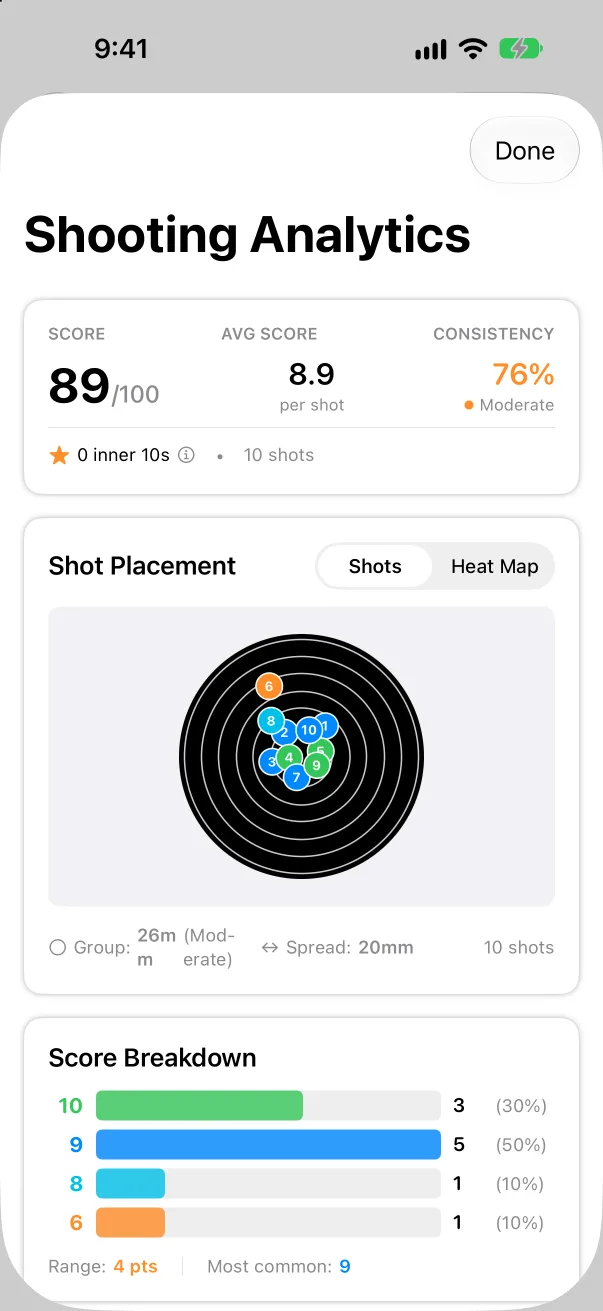
A score tells you how a card went. A group tells you why. Measuring it takes a ruler or a caliper and one subtraction.
1. Find the widest pair
Look for the two holes that sit furthest apart. Measure across them from outside edge to outside edge.
2. Take off one bullet diameter
Subtract the bullet diameter from that measurement. What is left is the distance between the centres of the two holes, which is the figure shooters compare.
A worked example: the widest pair on a .22 card measures 21.6 mm across. A .22 bullet is 5.6 mm, so the group is 16.0 mm centre to centre.
3. Turn it into an angle
A size only means something with its distance. One minute of angle is 1.047 inches at 100 yards, about 29 mm at 100 metres. One mrad is 100 mm at 100 metres.
The 16.0 mm group above, shot at 25 yards, is 2.41 MOA or 0.70 mrad. As an angle, a 25 yard card and a 50 metre card can be compared.
Size and place are two questions
A tight group away from the centre is a sighting problem. A loose group around the centre is a technique problem. Measure the group first, then look at where it sits. The sight calculator handles the second question.
Or photograph the card
Notch measures the group and the spread from a photo, for every card in a session, and keeps your tightest grouping in your records.
Updated 11 November 2026.
Questions
How do you measure group size?
Measure across the two holes furthest apart, outside edge to outside edge, then subtract one bullet diameter. The result is the centre-to-centre group size.
How do I convert a group to MOA?
Divide the group size in inches by the distance in hundreds of yards, then by 1.047. A 0.63 inch group at 25 yards is 2.41 MOA.
Is a small group the same as a good score?
No. A tight group away from the centre scores badly and usually means the sight needs moving. A loose group around the centre is a technique problem.