 Notch


 App of the Day
from the creators of
 murmur
 Layered
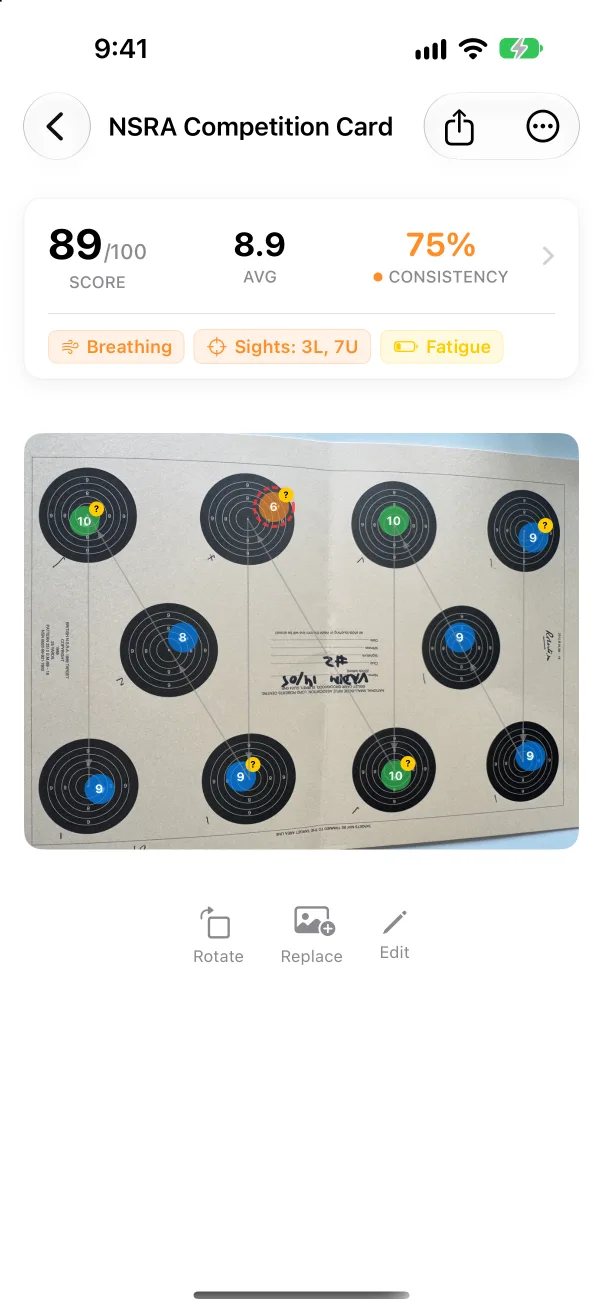
Scoring a card is a short routine. Find every shot, give each one a value, and settle the doubtful ones with a gauge. The details change with the discipline, so the rule book for yours has the last word.
1. Count the shots
Find every hole before you score any of them. A ten-shot card should show ten. If the count is off, examine the front and the back of the card for the missing hole.
2. Score the clear shots by eye
A shot takes the higher value when the edge of the hole touches the scoring ring. A hole that sits cleanly between two lines takes the lower value. Most shots on a card can be scored this way.
3. Gauge the doubtful ones
A scoring gauge, often called a plug, has a spindle that fits the shot hole and a flange turned to an exact size set by the rule book. You put it in the hole and read the edge of the flange, usually under a magnifier.
A hole is plugged once. In competition it is then marked, so nobody gauges it a second time.
Inward and outward gauges
Two kinds of gauge are in use, and they are read from opposite edges.
| Inward gauge | Outward gauge | |
|---|---|---|
| Read at | the edge of the flange nearest the centre | the outside edge of the flange |
| Higher value when | the flange touches the higher ring | the flange stays clear of the outer line |
| Typical use | targets shot at 25 yards or more | certain shots on 10 m air rifle and pistol targets, and some 50 foot smallbore targets |
Which gauge applies to your card, and its exact size, is set by your discipline's rules.
Where a phone fits
A photo does not replace the scorer at a match. It does give you a score in seconds for your own record. Notch finds each shot on the card, marks it and scores it, and you can correct a mark you disagree with. League and competition cards still go to the scorer.
Updated 11 November 2026.
Questions
How do you score a shot that touches the line?
It takes the higher value. If it is too close to call by eye, a scoring gauge settles it.
What is the difference between an inward and an outward scoring gauge?
An inward gauge is read at the edge of the flange nearest the centre: if it touches the higher ring, the shot gets the higher value. An outward gauge is read at the outside edge: if the flange touches the outer line, the shot gets the lower value.
Can an app score a competition card?
Notch scores a card from a photo for your own record. Competition cards are scored by the match or league scorer.